



10th
November
2026

The problem
Shopify expects every choice a customer makes on a product page to be a variant: a size, a colour, a length. Variants carry their own price and stock, and Shopify will not add a product to the cart until one is selected. Anything else the customer needs to tell you is optional by default. A theme can collect extra details as line item properties, but nothing stops the customer leaving them blank.
A recent client sells cloth by length, and every length leaves the business with a woven label in one of three types. The type decides how the order is prepared, so an order without it cannot be cut and packed. Turning the label into a variant would have tripled the variant count on every product and split the stock of a single bolt across three records. Leaving it to an order note meant the team chasing customers before work could start.
What we did
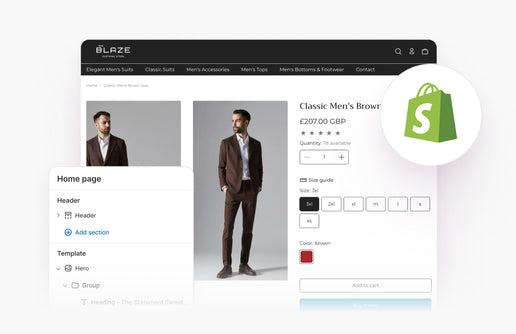
The label is a required select on the product page, built into the theme. It appears only when a length is selected, so customers ordering a sample skip it. The add to cart button will not submit until a label is chosen, and the prompt asks the customer to pick one.
The choice is saved as a line item property called Label. Shopify carries line item properties through the cart, checkout and order, so the value appears on the order in the admin and on the picking and production paperwork without any extra integration. The label has no effect on price, so stock and pricing stay on the length variant.
A link beside the select opens the size guide drawer at the section on labels, with a description of each type. Customers make the decision with the information in front of them, at the moment they are choosing a length.

Results
Every order now arrives with its label stated. The team cuts and packs from the order as placed, without contacting the customer first.
That removes a delay between payment and dispatch, and with it the orders that stall while a customer replies to an email. It also cuts the number of wrong labels, because the customer reads what each type is for before choosing, rather than guessing in an order note.
The alternatives would have cost more to run. Label variants would have meant three variants for every length, three stock counts to keep accurate for one bolt of cloth, and a real risk of overselling as stock moved between them. A product options app would have added a monthly fee and another dependency to the checkout for a single field. A required line item property leaves the product data exactly as it was.
One point to keep in mind: line item properties are saved as plain text on the order. Name the values exactly as the team uses them on the shop floor, so the paperwork needs no translation.
Selling products that need one more choice before they can be made or packed? Tell us about your project.
THE LATEST MARKETING INSIGHTS

