



10th
November
2026

The problem
Most Shopify stores that sell samples set them up as separate products. On a large range that doubles the catalogue: a second product for every fabric, with its own images, description and URL, all kept in step with the original by hand.
A recent client wanted samples on the same product page as the fabric itself, and wanted them orderable at all times, even when the fabric had sold out and was waiting to be restocked. Shopify reads a product as available if any of its variants can be bought. Once a sample can always be bought, every product looks in stock. The page opens on the wrong option, and back in stock apps, which read that same availability, stop offering alerts for the fabric customers actually want.
What we did
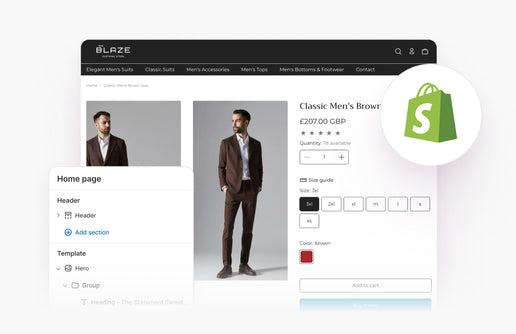
Every fabric has two variants: the length and a swatch. The swatch has tracked stock but is set to continue selling when out of stock, so a customer can always order one. An icon in the variant picker marks the swatch option, so it reads as a sample rather than a size.
The theme no longer relies on Shopify's own choice of the selected variant. When a customer lands on a product, the page opens on the length, and the swatch sits beside it as a second option.
For back in stock alerts, the theme checks the length variant directly. When the length is unavailable, the page shows the alert sign-up, even though the product as a whole still counts as available because of the swatch. Customers can order a swatch and ask to hear when the length returns, on the same page.

Results
Customers can always order a sample, and they are told when the fabric they want is back.
A sample request is one of the strongest buying signals a store gets. Keeping samples open while a fabric is sold out keeps that demand in the store during the wait, and the alert brings the customer back at the moment they can buy the full length. Without it, a sold out page is a dead end, and the customer looks elsewhere.
Separate sample products would have reached a similar result at a higher running cost: a second product for every fabric to create, photograph, describe and archive, and two URLs competing in search for the same cloth. A single product keeps one page, one set of images and one description, and the team adds a new fabric once.
The practical point: setting any variant to continue selling changes how product-level availability reads across the whole store. Check every feature that relies on it, including collection badges, filters and stock apps, before launch.
Selling samples alongside full products? Tell us about your project.
THE LATEST MARKETING INSIGHTS

